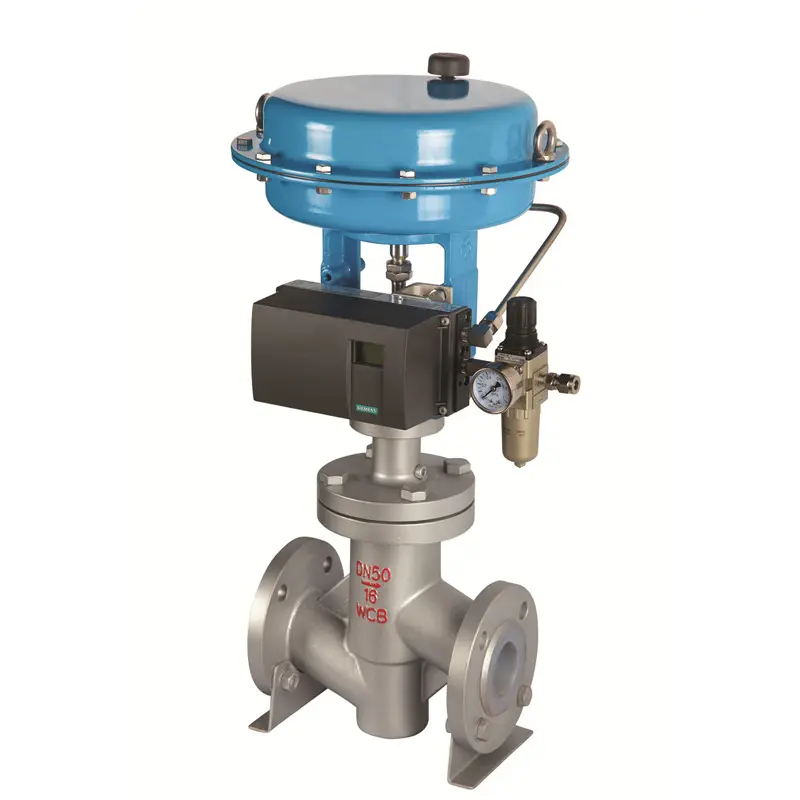
As global industries continue to demand higher performance from fluid-handling equipment, the need for durable, corrosion-resistant control valves has become more critical than ever. In chemical processing, pharmaceuticals, wastewater treatment, and other sectors where aggressive or hazardous media must be transported safely, traditional metal-seated valves often fall short due to corrosion, scaling, or chemical attack.
In response, fluorine-lined control valves—commonly using PTFE (polytetrafluoroethylene) or PFA (perfluoroalkoxy alkane)—have emerged as a leading solution for high-purity, high-corrosion environments. These specialized valves combine the structural integrity of a metal valve body with the exceptional chemical resistance of fluoropolymers, providing a leak-free, reliable performance even under the most demanding process conditions.
This industry news article explores the technological foundation of fluorine-lined control valves, their expanding applications, benefits, installation considerations, global market growth, and how these products are shaping the future of corrosive-media flow control.
Fluorine-lined control valves are a category of industrial control valves designed specifically for processes involving corrosive, toxic, or high-purity media. Their defining feature is an internal lining made of a chemically inert fluoropolymer—typically PTFE, PFA, FEP, or ETFE—that completely isolates the metal body and internal surfaces from the process fluid.
- Metal Body (Carbon Steel, Stainless Steel, or Alloy Steel)
Ensures mechanical strength, pressure containment, and structural durability.
- Fluoropolymer Lining (PTFE, PFA, FEP, ETFE)
Provides superior corrosion resistance against acids, alkalis, solvents, and chemical mixtures.
- Regulating Trim / Control Mechanism
May include plug, ball, disc, diaphragm, or segmented elements depending on the design.
- Actuation Options
Pneumatic, electric, or hydraulic actuators are used based on process control requirements.
Fluorine-containing polymers are chemically inert because of the strong carbon–fluorine bond, one of the strongest molecular bonds known. This allows the lining to withstand:
- Sulfuric acid (H₂SO₄)
- Hydrochloric acid (HCl)
- Hydrofluoric acid (HF)
- Sodium hydroxide (NaOH)
- Chlorine gas and chlorine-based disinfectants
- Organic solvents
- Saltwater and brine
While the outer steel body provides mechanical strength, the inner PTFE/PFA lining ensures years of corrosion-free operation.
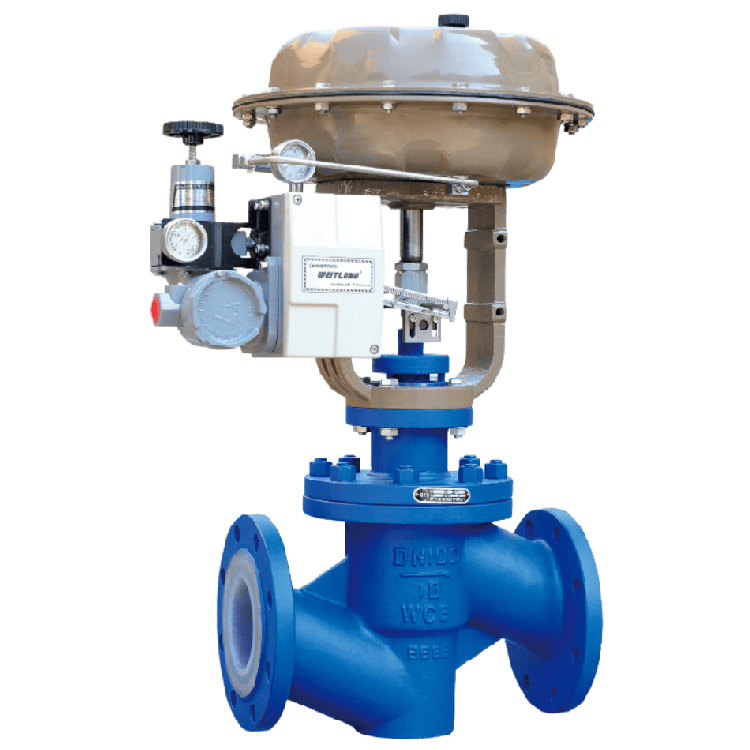
As global chemical production increases and processes shift toward more aggressive compounds, the demand for corrosion-resistant materials continues to rise. Unplanned maintenance caused by valve corrosion can lead to:
- expensive downtime
- environmental incidents
- contamination of high-purity media
- equipment failure
Fluorine-lined valves directly address these challenges by extending valve life cycles and reducing leakage risks.
Regulatory agencies such as EPA, OSHA, and European REACH have tightened restrictions on chemical emissions and industrial leakage. Plants handling hazardous substances must use valves that minimize release risks. Fluoropolymer-lined valves offer low-permeation surfaces and reliable sealing performance, contributing to safer, more environmentally compliant operations.
Using exotic metal alloys—such as Hastelloy, Inconel, or titanium—can be prohibitively expensive. Fluorine-lined control valves offer a cost-effective alternative by delivering similar corrosion performance at a lower price point.
The operational principle depends on the valve type (globe, ball, plug, or diaphragm). However, the goal is consistent across all designs: to regulate flow, pressure, temperature, and level with precision while preventing chemical attack.
1. Actuator Receives Control Signal
Input from PLC, DCS, or controller adjusts the actuator position.
2. Movement of Internal Trim
The plug, ball, or disc modulates flow passage area.
3. Fluorine Lining Protects Wetted Surfaces
Media contacts only PTFE or PFA, ensuring chemical isolation.
4. Achieving Setpoint Parameters
Flow rate, pressure, or temperature is regulated to maintain process stability.
Fluorine-lined control valves are ideal for:
- moderate pressure ranges
- temperatures typically between –20°C and 180°C (material-dependent)
- low to moderate allowable leakage
applications where metal valves may corrode or contaminate the process
The adoption of fluorine-lined valves is growing across a wide spectrum of industries. Below are the primary areas where they have become essential.
This is the largest user of fluorine-lined control valves. Chemical plants handle a wide variety of corrosive and toxic media that require fully protected valves.
Examples of applications include:
- acid storage and transfer
- alkali dosing systems
- polymer production
- chemical reactors
- solvent purification units
- fertilizer manufacturing
Processes using sulfuric acid, hydrochloric acid, chlorine, or caustic solutions rely on PTFE-lined valves to ensure both safety and reliability.
Pharmaceutical production requires contamination-free environments. PTFE and PFA are FDA-compliant materials with:
- smooth, non-stick surfaces
- low permeability
- resistance to biofouling
Fluorine-lined control valves are used for:
- CIP/SIP systems
- solvent handling
- high-purity water processes
- buffer and reagent dosing
- bioreactor flow control
Their inert nature ensures no cross-contamination or media reaction.
Industrial and municipal water treatment systems often use chemical additives that can corrode unprotected metal valves.
Fluorine-lined valves support:
- chlorine dosing
- pH regulation systems
- membrane cleaning processes
- seawater desalination
- wastewater neutralization
The lining prevents scaling and buildup, extending service life even in brine-rich environments.
Electronics manufacturing utilizes ultra-pure chemicals such as HF, HCl, and ammonium hydroxide. PTFE/PFA-lined valves ensure:
- high chemical purity
- zero metallic contamination
- excellent resistance to etching compounds
They are widely used in semiconductor wafer etching, chemical vapor deposition processes, and microelectronics cleaning systems.
Leaching operations involve highly corrosive solutions. Fluorine-lined control valves withstand:
- sulfuric acid leaching
- solvent extraction
- electrowinning processes
They maintain flow stability in abrasive and corrosive slurry environments.
Certain food-grade chemicals, preservatives, and sanitation solutions require corrosion-proof flow control. PTFE-lined valves comply with food safety standards and resist flavor or odor absorption.
Fluoropolymers withstand nearly all industrial chemicals. This greatly reduces the risk of corrosion-related failure and leakage.
Thanks to their smooth internal surfaces, fluorine-lined valves resist scaling, sticking, and buildup, lowering maintenance frequency.
PTFE and PFA linings ensure tight sealing even under dynamic control conditions.
Fluoropolymers handle hundreds of industrial chemicals, making them suitable for multi-chemical environments or processes with variable media.
Compared with high-nickel alloys or titanium valves, lined valves offer similar corrosion resistance at significantly lower cost.
Their resistance to wear, erosion, and chemical reaction contributes to extended operational lifespan.
Ideal for pharmaceuticals, electronics, and high-purity chemical manufacturing.
Fluorine lining can be applied to various valve configurations depending on application needs.
- Most precise flow control
- Ideal for sensitive modulation
- Used in chemical dosing and pharmaceutical applications
- Good for clean and corrosive media
- Lower flow resistance
- Suitable for bulk chemical transfer
- Excellent sealing characteristics
- Suitable for viscous or slurry media
- Lightweight and economical
- Good for low pressure and large-diameter pipelines
- High-purity operations
- Contamination-free sealing
Proper installation ensures optimal performance and longevity.
PTFE and PFA are durable yet can be damaged by sharp tools. Care should be taken during installation.
Misalignment may strain the lining, causing premature wear or deformation.
Fluoropolymer or soft non-reactive gaskets are recommended.
Excess force may distort the lining and reduce sealing performance.
Always operate within the recommended material limits.
Wastewater recycling, chemical recovery, and green manufacturing initiatives require corrosion-resistant flow control equipment.
Global manufacturers are scaling up production of fluoropolymers to meet demand in the valve industry.
Modern fluorine-lined control valves are increasingly paired with smart electric actuators featuring:
- remote diagnostics
- real-time position monitoring
- IoT and cloud connectivity
Chemical and petrochemical investments in China, India, and GCC countries are driving large-scale adoption.
PTFE typically withstands up to 180°C; exceeding this may degrade the material.
The lining requires careful handling.
Erosion risk increases under extreme turbulence.
The fluorine-lined valve market is expected to expand significantly due to:
- stronger environmental regulations
- increasing industrial automation
- rising chemical production volumes
- growth of high-purity manufacturing
Manufacturers are exploring next-generation fluoropolymers with improved heat resistance, enhanced mechanical strength, and lower permeability. The integration of digital control systems and advanced actuator technologies will further strengthen the adoption of fluorine-lined control valves in automated industrial networks.
Fluorine-lined control valves represent a vital innovation in modern fluid-control engineering. By combining the structural strength of metal valves with the exceptional corrosion resistance of fluoropolymers, they provide a durable, cost-effective, and highly reliable solution for industries handling corrosive or high-purity media.
Their expanding use across chemical processing, pharmaceuticals, water treatment, mining, and other sectors highlights their value in maintaining operational safety, reducing maintenance costs, and improving process efficiency.
As industries continue to pursue higher sustainability standards and technological advancement, fluorine-lined control valves will play an increasingly important role in future fluid-control infrastructure.