Tri Clamp Food Grade Pneumatic Ball Valve: Hygienic Flow Control for Modern Food and Beverage Processing
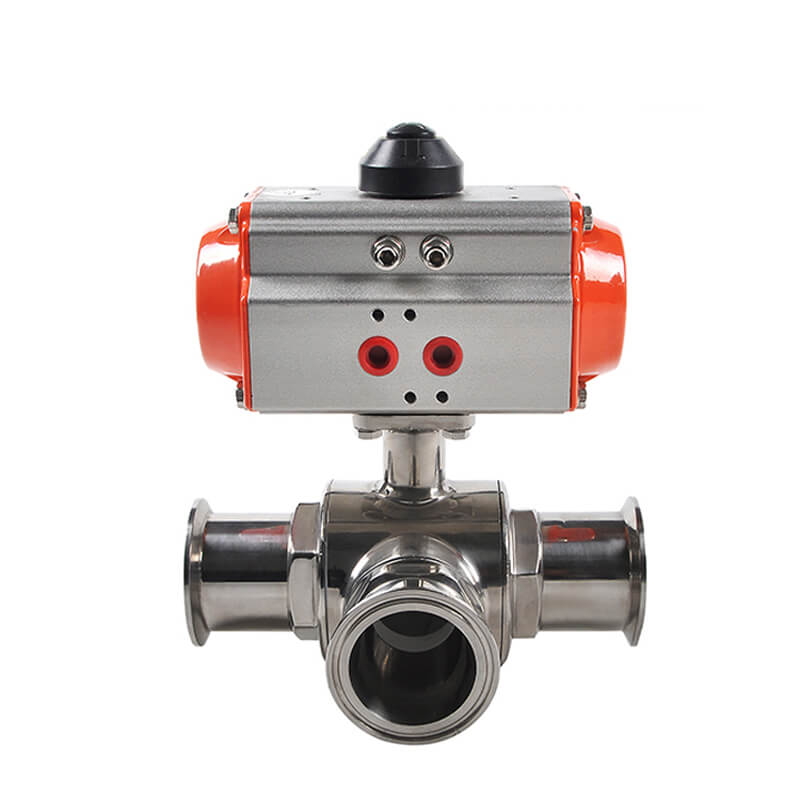
In industries where hygiene, product purity, and strict sanitary standards are essential, valve technology plays a critical role in maintaining safe and efficient production processes. Food, beverage, pharmaceutical, and biotechnology facilities require equipment that can deliver precise flow control while meeting rigorous cleanliness and contamination prevention requirements. Among the many valve solutions available today, the Tri Clamp Food Grade Pneumatic Ball Valve has emerged as one of the most reliable and efficient components for sanitary fluid control systems.
This specialized valve combines the durability of stainless steel construction, the efficiency of pneumatic automation, and the convenience of tri-clamp sanitary connections. Designed to handle liquids such as water, milk, soft drinks, syrups, and pharmaceutical fluids, the valve provides fast, reliable operation while ensuring compliance with strict food safety standards.
A key feature of sanitary pneumatic ball valves is their ability to perform multiple flow control functions, including directing, diverting, or mixing fluids. In particular, the three-way configuration allows flexible flow management through two different internal port structures: T-port and L-port designs. These options allow engineers to customize flow direction control based on process requirements.
With advanced polishing, sterilization-friendly construction, and actuator lifespans reaching up to one million cycles, tri-clamp pneumatic ball valves are becoming essential equipment across modern sanitary production systems. This article explores their design, working principles, advantages, applications, and the role they play in improving efficiency and safety across various hygienic industries.
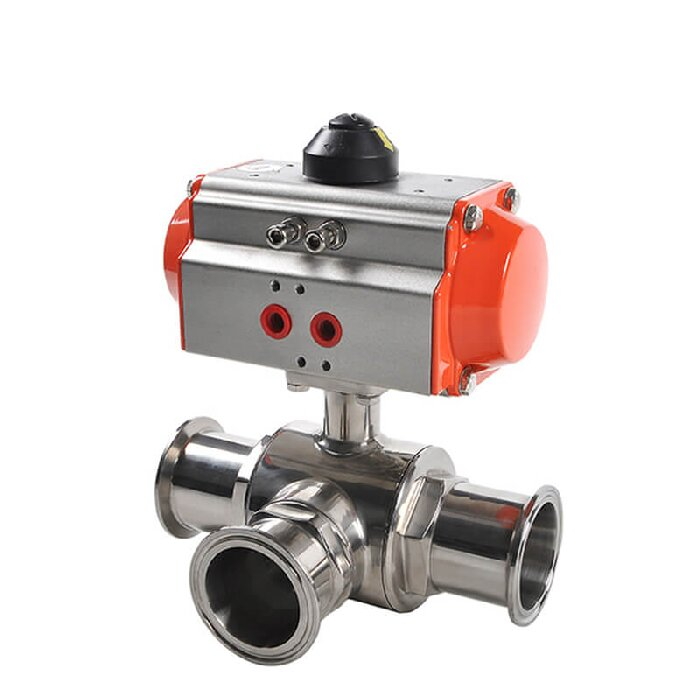
A Tri Clamp Food Grade Pneumatic Ball Valve is a sanitary valve designed for automated flow control in hygienic pipelines. The valve uses compressed air to drive a pneumatic actuator, which rotates a ball inside the valve body to control fluid flow.
The valve body is typically constructed from stainless steel 304 or 316L, materials widely recognized for their corrosion resistance, strength, and suitability for food-grade applications. The internal surfaces of the valve are precision-polished to eliminate rough areas where bacteria or contaminants might accumulate.
The tri-clamp connection, also known as a sanitary clamp fitting, is commonly used in industries requiring frequent cleaning and disassembly. This connection method allows quick installation and removal without complex tools, supporting efficient maintenance and sanitation procedures.
The combination of hygienic materials, smooth internal surfaces, and quick-connect fittings ensures that these valves meet the strict sanitation requirements demanded by food processing and pharmaceutical industries.
The operation of a pneumatic ball valve is based on the rotation of a spherical ball with a hole through its center. When the hole aligns with the pipeline, fluid flows through the valve. When the ball rotates 90 degrees, the hole becomes perpendicular to the flow path, stopping the flow completely.
In a pneumatic valve, this rotation is controlled by a compressed-air-powered actuator mounted on the valve stem. When air pressure is applied, the actuator moves the stem, rotating the ball to open or close the valve.
Pneumatic actuators typically operate within an air supply pressure range of 2.5 bar to 8 bar, ensuring consistent and reliable performance across industrial automation systems.
These actuators are available in two main configurations:
A spring return actuator uses compressed air to move the valve into one position and a spring mechanism to return it to its default state when air pressure is removed. This design provides a fail-safe function, ensuring the valve returns to a safe position during power or air supply failures.
A double acting actuator uses compressed air to both open and close the valve. This design provides greater control and is often used in automated process control systems where precise valve positioning is required.
Both actuator types offer fast response times, enabling quick opening and closing actions that improve production efficiency and system safety.
One of the most important features of sanitary three-way ball valves is their ability to control flow direction using different internal port configurations.
The T-port design allows fluid to flow in multiple directions simultaneously. The internal bore of the ball is shaped like the letter "T", enabling three different flow paths.
This configuration can perform functions such as:
- Mixing two fluid streams into one outlet
- Diverting a single inlet to two outlets
- Allowing continuous flow between multiple pipelines
T-port valves are commonly used in processes where fluid distribution or mixing is required.
The L-port design connects two ports at a time while isolating the third. The internal bore resembles the letter "L", directing flow between two selected ports.
This configuration is typically used for:
- Diverting flow between two outlets
- Switching flow direction within a pipeline system
- L-port valves are widely used in systems where fluid routing must alternate between different processing lines.
The availability of both configurations provides engineers with flexible options for optimizing pipeline flow control.
Tri Clamp Food Grade Pneumatic Ball Valves are designed to operate under a wide range of industrial conditions. Typical technical specifications include:
- Body Material: Stainless Steel 304, 316, or 316L
- Pressure Rating: Up to 10 bar (145 psi)
- Temperature Range: -10°C to 180°C (14°F to 356°F)
- Actuator Type: Spring Return or Double Acting
- Air Supply Pressure: 2.5 to 8 bar
- Valve Configuration: Three-way T-port or L-port
- Connection Type: Sanitary Tri-Clamp
- Cycle Life: Up to 1,000,000 operating cycles
These specifications ensure that the valve can handle both high-temperature and corrosive fluid environments while maintaining reliable long-term performance.
Maintaining hygiene is a top priority in industries such as food processing and pharmaceuticals. Sanitary valves must prevent contamination, support easy cleaning, and maintain product purity throughout the production process.
Tri-clamp pneumatic ball valves incorporate several design features that support hygienic operation.
The internal surfaces of the valve body are precision polished to achieve a smooth finish. This reduces the risk of bacterial buildup and prevents residue from accumulating inside the valve.
The valve uses food-grade sealing materials that comply with safety standards for food and pharmaceutical applications. These seals prevent leakage and contamination while maintaining chemical resistance.
The valve design supports CIP (Clean-In-Place) and SIP (Sterilization-In-Place) processes commonly used in sanitary industries. This allows cleaning and sterilization without removing the valve from the pipeline.
The use of stainless steel ensures strong resistance to corrosion caused by acidic liquids, cleaning chemicals, and high-temperature sterilization processes.
These hygienic features make pneumatic sanitary ball valves ideal for environments where cleanliness and safety are critical.
Sanitary pneumatic ball valves offer numerous operational advantages that improve both productivity and safety in industrial processing systems.
Pneumatic actuators allow valves to open and close quickly, improving process efficiency and enabling seamless integration with automated production lines.
With a lifespan of up to one million cycles, these actuators are designed for long-term reliability, reducing maintenance frequency and operating costs.
Pneumatic systems operate using compressed air rather than electrical power, making them suitable for environments where explosion-proof equipment is required.
Air-powered actuators produce no electrical sparks and consume relatively low energy, making them environmentally friendly solutions.
The availability of T-port and L-port configurations allows versatile control of fluid distribution, mixing, and diversion.
Automated valves reduce manual intervention, increase production speed, and improve consistency in industrial processes.
Tri Clamp Food Grade Pneumatic Ball Valves are widely used in industries that require sanitary and precise fluid handling.
Food production facilities rely on sanitary valves to maintain product purity and meet strict hygiene regulations. These valves are commonly used in processing lines for dairy products, beverages, sauces, and syrups.
Breweries and beverage plants require reliable fluid control systems for transferring liquids such as beer, wine, juice, and soft drinks. Pneumatic ball valves ensure efficient flow management throughout the brewing and bottling process.
Pharmaceutical production involves sensitive liquids and strict cleanliness requirements. Sanitary valves help maintain sterile conditions while ensuring precise control of process fluids.
Biotechnology laboratories and manufacturing facilities use sanitary valves in fermentation systems and biochemical processing lines.
Certain chemical applications require corrosion-resistant valves capable of handling aggressive fluids. Stainless steel sanitary ball valves provide durability and reliability in these environments.
Water purification and treatment plants use these valves to control fluid flow in filtration and distribution systems.
Modern manufacturing facilities are increasingly adopting automated control systems to improve efficiency, safety, and product quality.
Pneumatic valves play a crucial role in this transformation by providing reliable and rapid flow control within automated pipelines.
Automated valve systems allow operators to monitor and control processes remotely, reducing manual labor and minimizing human error.
In addition, automated valves support smart manufacturing systems, where sensors and digital monitoring technologies work together to optimize production processes.
As industries continue to move toward digitalization and Industry 4.0, the demand for automated sanitary valve solutions is expected to grow significantly.
The future of sanitary valve technology is closely linked to advances in automation, digital monitoring, and materials engineering.
Manufacturers are developing smarter valve systems equipped with sensors that provide real-time feedback on valve position, pressure, and system performance.
New materials and advanced surface finishing techniques are also improving corrosion resistance and extending valve lifespans.
Furthermore, integration with industrial control systems and IoT technologies is enabling predictive maintenance strategies that reduce downtime and improve operational efficiency.
As the global demand for safe food production, pharmaceutical manufacturing, and clean water continues to rise, hygienic valve technology will remain an essential component of modern industrial infrastructure.
The Tri Clamp Food Grade Pneumatic Ball Valve represents an advanced solution for hygienic fluid control across multiple industries. Combining sanitary stainless steel construction, automated pneumatic actuation, and flexible flow direction configurations, these valves deliver reliable performance in demanding environments.
With features such as precision-polished surfaces, food-grade sealing materials, and tri-clamp connections, they meet strict sanitation requirements while ensuring efficient operation.
Their ability to perform multiple flow control functions using T-port and L-port configurations makes them versatile components in complex pipeline systems.
As industries continue to prioritize hygiene, automation, and efficiency, pneumatic sanitary ball valves will play an increasingly important role in supporting safe, reliable, and high-performance processing systems worldwide.